Search This Blog

Tuesday, October 11, 2016

Obama Shows Presidential Erection to Adoring Staffers

Disgusting: New video surfaces of Obama showing off his erection in-front of aides on his plane. Listen to their comments...


Wednesday, November 25, 2015

MSNBC's 'No-Fly List Is Islamophobia' Poster Boy Arrested in Turkey as Part of ISIS Cell


A man, who just two years ago was the poster boy for the far-Left media's attacks against the U.S. government's no-fly list for "unfairly" targeting Muslims, finds himself and several family members sitting in a Turkish prison -- arrested earlier this month near the Turkey-Syria border as members of an ISIS cell.

It's a long way from 2013 when Saadiq Long's cause was being championed by MSNBC's Chris Hayes, Glenn Greenwald, and Mother Jones, and was being represented by the Council on American-Islamic Relations (CAIR) terror front.

His story got considerable media attention when his CAIR media representatives here pushed the story that Long wanted to return to his native Oklahoma from his current home in Qatar to visit his ailing mother but couldn't because he was on the TSA's no-fly list. They said his case represented institutional "Islamophobia."


Long's cause got international attention when Glenn Greenwald published an article at The Guardian saying that Long was "effectively exiled from his own country." Kevin Drum of Mother Jones branded it the "Kafkaesque World of the No-Fly List." CAIR has 22 article entries related to Long's case on its website.

After several months of wrangling between his CAIR attorneys and the Department of Homeland Security, Long was temporarily removed from the no-fly list and allowed to return to Oklahoma.
Once home, however, he was still subject to FBI surveillance according to claims he made during a press conference with his CAIR handlers.

After an incident with local police and the FBI, Long was apparently placed back on the no-fly list, preventing his return to Qatar.

That prompted even more outrage from the far-Left media and garnered him an appearance with his CAIR handler on Chris Hayes' MSNBC show:


For more on this story: PJ Media


Saturday, July 18, 2015

Society of Professional Journalists Code Of Ethics That The Main Stream Media Is Not Abiding By


Please share this on all of the websites of Left-Wing media outlets that profess to be reporting news accurately.  Please also share on the Facebook page, Twitter account, or any Website etc. of individual reporters, bloggers that are espousing lies to cover for the corruption of this administration and inaccurately reporting the news to their viewers.

After reading through the Code of Ethics they should be abiding by, I have concluded Obama and his talking heads don't have any ethics and need a refresher course. 

Sept 29, 2011
Obama: 'I Don't Think Ethics' Was My Favorite Subject
Obama told an audience of high school students in Washington, D.C. that he was "not always the very best student" and that ethics "would not have made it on the list" of his favorite subjects.

Relationship with freedom of the press

In countries without freedom of the press, the majority of people who report the news may not follow the standards of journalism. Non-free media are often prohibited from criticizing the national government, and in many cases are required to distribute propaganda as if it were news. Various other forms of censorship may restrict reporting on issues the government deems sensitive.

 That sure sounds like the majority of the media in the United States of America, doesn't it?
*****************************************

These guidelines inspired Society of Professional Journalists which is the current version of media ethics that were adopted in 1996.

Society of Professional Journalists: Code of Ethics

The Society of Professional Journalists created a code of ethics that are in effect today. The main mantra of the code is "Seek truth and Report it!"(Straubhaar, LaRose & Davenport, Pg 478) The code also states that: "Journalists should be honest, fair, and courageous in gathering, reporting, and interpreting information. Journalists should:"
  • "Test the accuracy of information from all sources and exercise care to avoid inadvertent error. Deliberate distortion is never permissible."(Straubhaar, LaRose & Davenport, Pg 478)
  • "Diligently seek out subjects of news stories to give them the opportunity to respond to allegations of wrongdoing."(Straubhaar, LaRose & Davenport, Pg 478)
  • "Identify sources whenever feasible. The public is entitled to as much information as possible on sources' reliability." (Straubhaar, LaRose & Davenport, Pg 478)
  • "Always question sources' motives before promising anonymity. Clarify conditions attached to any promise made in exchange for information. Keep promises." (Straubhaar, LaRose & Davenport, Pg 478)
  • "Make certain that headlines, news teases, and promotional material, photos, video, audio, graphics, sound bites, and quotations do not misrepresent. They should not oversimplify or highlight incidents out of context." (Straubhaar, LaRose & Davenport, Pg 478)
  • "Never distort the content of news photos or video. Image enhancement for technical clarity is always permissible. Label montages and photo illustrations." (Straubhaar, LaRose & Davenport, Pg 478)
  • "Avoid misleading reenactments or staged news events. If reenactment is necessary to tell a story, label it." (Straubhaar, LaRose & Davenport, Pg 478)
  • "Avoid undercover or other surreptitious methods of gathering information except when traditional open methods will not yield information vital to the public. Use of such methods should be explained as part of the story." (Straubhaar, LaRose & Davenport, Pg 478)
  • "Never plagiarize." (Straubhaar, LaRose & Davenport, Pg 478)
  • "Tell the story of the diversity and magnitude of the human experience boldly, even, when it is unpopular to do so." (Straubhaar, LaRose & Davenport, Pg 478)
  • "Examine their own cultural values and avoid imposing those values on others." (Straubhaar, LaRose & Davenport, Pg 478)
  • "Avoid stereotyping by race, gender, age, religion, ethnicity, geography, sexual orientation, disability, physical appearance, or social status." (Straubhaar, LaRose & Davenport, Pg 478)
  • "Support the open exchange of views, even views they find repugnant." (Straubhaar, LaRose & Davenport, Pg 478)
  • "Give voice to the voiceless; official and unofficial sources of information can be equally valid." (Straubhaar, LaRose & Davenport, Pg 478)
  • "Distinguish between advocacy and news reporting. Analysis and commentary should be labeled and not misrepresent fact or content." (Straubhaar, LaRose & Davenport, Pg 478)
  • "Distinguish news from advertising, and shun hybrids that blur the lines between the two." (Straubhaar, LaRose & Davenport, Pg 478)
  • "Recognize a special obligation to ensure that the public's business is conducted in the open and that government records are open to inspection." (Straubhaar, LaRose & Davenport, Pg 478)
Minimize Harm "Ethical journalists treat sources, subjects, and colleagues as human beings deserving of respect. Journalists should" (Straubhaar, LaRose & Davenport, Pg 478)
  • "Show compassion for those who may be affected adversely by news coverage. Use special sensitivity when dealing with children and inexperienced sources or subjects." (Straubhaar, LaRose & Davenport, Pg 478)
  • "Be sensitive when seeking or using interviews or photographs of those affected by tragedy or guilt." (Straubhaar, LaRose & Davenport, Pg 478)
  • "Recognize that gathering and reporting information may cause harm or discomfort. Pursuit of the news is not a license for arrogance." (Straubhaar, LaRose & Davenport, Pg 478)
  • "Recognize that private people have a greater right to control information about themselves that do public officials and others who seek power, influence, or attention. Only an overriding public need can justify intrusion into anyone's privacy." (Straubhaar, LaRose & Davenport, Pg 478)
  • "Show good taste. Avoid pandering to lurid curiosity." (Straubhaar, LaRose & Davenport, Pg 478)
  • "Be cautions of identifying juvenile suspects or victims of sex crimes." (Straubhaar, LaRose & Davenport, Pg 478)
  • "Be judicious about naming criminal suspects before the formal filing of charges." (Straubhaar, LaRose & Davenport, Pg 478)
  • "Balance a criminal suspect's fair trial rights with the public's right to be informed." (Straubhaar, LaRose & Davenport, Pg 478)
Act Independently "Journalists should be free of obligation to any interest other than the public's right to know. Journalists should" ." (Straubhaar, LaRose & Davenport, Pg 478)
  • "Avoid conflict of interest, real or perceived." (Straubhaar, LaRose & Davenport, Pg 478)
  • "Remain free of associations and activities that may compromise integrity or damage credibility." (Straubhaar, LaRose & Davenport, Pg 478)
  • "Refuse gifts, favors, fees, free travel, and special treatment, and shun secondary employment, political involvement, public office, and service in community organizations if they compromise journalistic integrity." (Straubhaar, LaRose & Davenport, Pg 478)
  • "Disclose unavoidable conflicts." (Straubhaar, LaRose & Davenport, Pg 479)
  • "Be vigilant and courageous about holding those with power accountable." (Straubhaar, LaRose & Davenport, Pg 479)
  • "Deny favored treatment to advertisers and special interests and resist their pressure to influence news coverage." (Straubhaar, LaRose & Davenport, Pg 479)
  • "Be wary of sources offering information for favors or money; avoid bidding for news." (Straubhaar, LaRose & Davenport, Pg 479)
Be Accountable "Journalists are accountable to their readers, listeners, viewers, and each other. Journalists should:" (Straubhaar, LaRose & Davenport, Pg 479)
  • "Clarify and explain news coverage and invite dialogue with the public over journalistic conduct." (Straubhaar, LaRose & Davenport, Pg 479)
  • "Encourage the public to voice grievances against the news media." (Straubhaar, LaRose & Davenport, Pg 479)
  • "Admit mistakes and correct them promptly." (Straubhaar, LaRose & Davenport, Pg 479)
  • "Expose unethical practices of journalists and the news media." (Straubhaar, LaRose & Davenport, Pg 479)
  • "Abide by the same high standards to which they hold others." (Straubhaar, LaRose & Davenport, Pg 479)
All of these guidelines are for the betterment of society and regulation of media.
*************************************** 
REVISED 2014 VERSION:
Ethics Code Revision: Final Draft as approved by the SPJ Ethics Committee Updated 1:30 p.m.Saturday, Sept. 6, 2014

Preamble

Members of the Society of Professional Journalists believe that public enlightenment is the forerunner of justice and the foundation of democracy. Ethical journalism strives to ensure the free exchange of information that is accurate, fair and thorough. An ethical journalist acts with integrity.

The Society declares these four principles as the foundation of ethical journalism and encourages their use in its practice by all people in all media.

Seek Truth and Report It

Ethical journalism should be accurate and fair. Journalists should be honest and courageous in gathering, reporting and interpreting information.

Journalists should:

– Take responsibility for the accuracy of their work. Verify information before releasing it. Use original sources whenever possible.

– Remember that neither speed nor format excuses inaccuracy.

– Provide context. Take special care not to misrepresent or oversimplify in promoting, previewing or summarizing a story.

– Gather, update and correct information throughout the life of a news story.

– Be cautious when making promises, but keep the promises they make.

– Identify sources clearly. The public is entitled to as much information as possible to judge the reliability and motivations of sources.

– Consider sources’ motives before promising anonymity. Reserve anonymity for sources who may face danger, retribution or other harm, and have information that cannot be obtained elsewhere. Explain why anonymity was granted.

– Diligently seek subjects of news coverage to allow them to respond to criticism or allegations of wrongdoing.

– Avoid undercover or other surreptitious methods of gathering information unless traditional, open methods will not yield information vital to the public.

– Be vigilant and courageous about holding those with power accountable. Give voice to the voiceless.

– Support the open and civil exchange of views, even views they find repugnant.

– Recognize a special obligation to serve as watchdogs over public affairs and government. Seek to ensure that the public’s business is conducted in the open, and that public records are open to all.

– Provide access to source material when it is relevant and appropriate.

– Boldly tell the story of the diversity and magnitude of the human experience. Seek sources whose voices we seldom hear.

– Avoid stereotyping. Journalists should examine the ways their values and experiences may shape their reporting.

– Label advocacy and commentary.

– Never deliberately distort facts or context, including visual information. Clearly label illustrations and re-enactments.

– Never plagiarize. Always attribute.

  Minimize Harm

Ethical journalism treats sources, subjects, colleagues and members of the public as human beings deserving of respect.

Journalists should:
– Balance the public’s need for information against potential harm or discomfort. Pursuit of the news is not a license for arrogance or undue intrusiveness.

– Show compassion for those who may be affected by news coverage. Use heightened sensitivity when dealing with juveniles, victims of sex crimes, and sources or subjects who are inexperienced or unable to give consent. Consider cultural differences in approach and treatment.

– Recognize that legal access to information differs from an ethical justification to publish or broadcast.

– Realize that private people have a greater right to control information about themselves than public figures and others who seek power, influence or attention. Weigh the consequences of publishing or broadcasting personal information.

– Avoid pandering to lurid curiosity, even if others do.

– Balance a suspect’s right to a fair trial with the public’s right to know. Consider the implications of identifying criminal suspects before they face legal charges.

– Consider the long-term implications of the extended reach and permanence of publication. Provide updated and more complete information as appropriate.

Act Independently

The highest and primary obligation of ethical journalism is to serve the public.

Journalists should:
– Avoid conflicts of interest, real or perceived. Disclose unavoidable conflicts.

– Refuse gifts, favors, fees, free travel and special treatment, and avoid political and other outside activities that may compromise integrity or impartiality, or may damage credibility.

– Be wary of sources offering information for favors or money; do not pay for access to news. Identify content provided by outside sources, whether paid or not.

– Deny favored treatment to advertisers, donors or any other special interests, and resist internal and external pressure to influence coverage.

– Distinguish news from advertising and shun hybrids that blur the lines between the two. Prominently label sponsored content.

Be Accountable and Transparent

Ethical journalism means taking responsibility for one’s work and explaining one’s decisions to the public.

Journalists should:
– Explain ethical choices and processes to audiences. Encourage a civil dialogue with the public about journalistic practices, coverage and news content.

– Respond quickly to questions about accuracy, clarity and fairness.

– Acknowledge mistakes and correct them promptly and prominently. Explain corrections and clarifications carefully and clearly.

– Expose unethical conduct in journalism, including within their organizations.

– Abide by the same high standards they expect of others.
The SPJ Code of Ethics is a statement of abiding principles supported by additional explanations and position papers that address changing journalistic practices. It is not a set of rules, rather a guide that encourages all who engage in journalism to take responsibility for the information they provide, regardless of medium. The code should be read as a whole; individual principles should not be taken out of context. It is not, nor can it be under the First Amendment, legally enforceable.

Sigma Delta Chi's first Code of Ethics was borrowed from the American Society of Newspaper Editors in 1926. In 1973, Sigma Delta Chi wrote its own code, which was revised in 1984, 1987, 1996 and 2014.

Other Sources of Ethics In Journalism:
Reuters Handbook Of Journalism


Society of Professional Journalists Code Of Ethics That The Main Stream Media Is Not Abiding By


Please share this on all of the websites of Left-Wing media outlets that profess to be reporting news accurately.  Please also share on the Facebook page, Twitter account, or any Website etc. of individual reporters, bloggers that are espousing lies to cover for the corruption of this administration and inaccurately reporting the news to their viewers.

After reading through the Code of Ethics they should be abiding by, I have concluded Obama and his talking heads don't have any ethics and need a refresher course. 


Relationship with freedom of the press

In countries without freedom of the press, the majority of people who report the news may not follow the standards of journalism. Non-free media are often prohibited from criticizing the national government, and in many cases are required to distribute propaganda as if it were news. Various other forms of censorship may restrict reporting on issues the government deems sensitive.

 That sure sounds like the majority of the media in the United States of America, doesn't it?
*****************************************

These guidelines inspired Society of Professional Journalists which is the current version of media ethics that were adopted in 1996.

Society of Professional Journalists: Code of Ethics

The Society of Professional Journalists created a code of ethics that are in effect today. The main mantra of the code is "Seek truth and Report it!"(Straubhaar, LaRose & Davenport, Pg 478) The code also states that: "Journalists should be honest, fair, and courageous in gathering, reporting, and interpreting information. Journalists should:"
  • "Test the accuracy of information from all sources and exercise care to avoid inadvertent error. Deliberate distortion is never permissible."(Straubhaar, LaRose & Davenport, Pg 478)
  • "Diligently seek out subjects of news stories to give them the opportunity to respond to allegations of wrongdoing."(Straubhaar, LaRose & Davenport, Pg 478)
  • "Identify sources whenever feasible. The public is entitled to as much information as possible on sources' reliability." (Straubhaar, LaRose & Davenport, Pg 478)
  • "Always question sources' motives before promising anonymity. Clarify conditions attached to any promise made in exchange for information. Keep promises." (Straubhaar, LaRose & Davenport, Pg 478)
  • "Make certain that headlines, news teases, and promotional material, photos, video, audio, graphics, sound bites, and quotations do not misrepresent. They should not oversimplify or highlight incidents out of context." (Straubhaar, LaRose & Davenport, Pg 478)
  • "Never distort the content of news photos or video. Image enhancement for technical clarity is always permissible. Label montages and photo illustrations." (Straubhaar, LaRose & Davenport, Pg 478)
  • "Avoid misleading reenactments or staged news events. If reenactment is necessary to tell a story, label it." (Straubhaar, LaRose & Davenport, Pg 478)
  • "Avoid undercover or other surreptitious methods of gathering information except when traditional open methods will not yield information vital to the public. Use of such methods should be explained as part of the story." (Straubhaar, LaRose & Davenport, Pg 478)
  • "Never plagiarize." (Straubhaar, LaRose & Davenport, Pg 478)
  • "Tell the story of the diversity and magnitude of the human experience boldly, even, when it is unpopular to do so." (Straubhaar, LaRose & Davenport, Pg 478)
  • "Examine their own cultural values and avoid imposing those values on others." (Straubhaar, LaRose & Davenport, Pg 478)
  • "Avoid stereotyping by race, gender, age, religion, ethnicity, geography, sexual orientation, disability, physical appearance, or social status." (Straubhaar, LaRose & Davenport, Pg 478)
  • "Support the open exchange of views, even views they find repugnant." (Straubhaar, LaRose & Davenport, Pg 478)
  • "Give voice to the voiceless; official and unofficial sources of information can be equally valid." (Straubhaar, LaRose & Davenport, Pg 478)
  • "Distinguish between advocacy and news reporting. Analysis and commentary should be labeled and not misrepresent fact or content." (Straubhaar, LaRose & Davenport, Pg 478)
  • "Distinguish news from advertising, and shun hybrids that blur the lines between the two." (Straubhaar, LaRose & Davenport, Pg 478)
  • "Recognize a special obligation to ensure that the public's business is conducted in the open and that government records are open to inspection." (Straubhaar, LaRose & Davenport, Pg 478)
Minimize Harm "Ethical journalists treat sources, subjects, and colleagues as human beings deserving of respect. Journalists should" (Straubhaar, LaRose & Davenport, Pg 478)
  • "Show compassion for those who may be affected adversely by news coverage. Use special sensitivity when dealing with children and inexperienced sources or subjects." (Straubhaar, LaRose & Davenport, Pg 478)
  • "Be sensitive when seeking or using interviews or photographs of those affected by tragedy or guilt." (Straubhaar, LaRose & Davenport, Pg 478)
  • "Recognize that gathering and reporting information may cause harm or discomfort. Pursuit of the news is not a license for arrogance." (Straubhaar, LaRose & Davenport, Pg 478)
  • "Recognize that private people have a greater right to control information about themselves that do public officials and others who seek power, influence, or attention. Only an overriding public need can justify intrusion into anyone's privacy." (Straubhaar, LaRose & Davenport, Pg 478)
  • "Show good taste. Avoid pandering to lurid curiosity." (Straubhaar, LaRose & Davenport, Pg 478)
  • "Be cautions of identifying juvenile suspects or victims of sex crimes." (Straubhaar, LaRose & Davenport, Pg 478)
  • "Be judicious about naming criminal suspects before the formal filing of charges." (Straubhaar, LaRose & Davenport, Pg 478)
  • "Balance a criminal suspect's fair trial rights with the public's right to be informed." (Straubhaar, LaRose & Davenport, Pg 478)
Act Independently "Journalists should be free of obligation to any interest other than the public's right to know. Journalists should" ." (Straubhaar, LaRose & Davenport, Pg 478)
  • "Avoid conflict of interest, real or perceived." (Straubhaar, LaRose & Davenport, Pg 478)
  • "Remain free of associations and activities that may compromise integrity or damage credibility." (Straubhaar, LaRose & Davenport, Pg 478)
  • "Refuse gifts, favors, fees, free travel, and special treatment, and shun secondary employment, political involvement, public office, and service in community organizations if they compromise journalistic integrity." (Straubhaar, LaRose & Davenport, Pg 478)
  • "Disclose unavoidable conflicts." (Straubhaar, LaRose & Davenport, Pg 479)
  • "Be vigilant and courageous about holding those with power accountable." (Straubhaar, LaRose & Davenport, Pg 479)
  • "Deny favored treatment to advertisers and special interests and resist their pressure to influence news coverage." (Straubhaar, LaRose & Davenport, Pg 479)
  • "Be wary of sources offering information for favors or money; avoid bidding for news." (Straubhaar, LaRose & Davenport, Pg 479)
Be Accountable "Journalists are accountable to their readers, listeners, viewers, and each other. Journalists should:" (Straubhaar, LaRose & Davenport, Pg 479)
  • "Clarify and explain news coverage and invite dialogue with the public over journalistic conduct." (Straubhaar, LaRose & Davenport, Pg 479)
  • "Encourage the public to voice grievances against the news media." (Straubhaar, LaRose & Davenport, Pg 479)
  • "Admit mistakes and correct them promptly." (Straubhaar, LaRose & Davenport, Pg 479)
  • "Expose unethical practices of journalists and the news media." (Straubhaar, LaRose & Davenport, Pg 479)
  • "Abide by the same high standards to which they hold others." (Straubhaar, LaRose & Davenport, Pg 479)
All of these guidelines are for the betterment of society and regulation of media.
*************************************** 
REVISED 2014 VERSION:
Ethics Code Revision: Final Draft as approved by the SPJ Ethics Committee Updated 1:30 p.m.Saturday, Sept. 6, 2014

Preamble

Members of the Society of Professional Journalists believe that public enlightenment is the forerunner of justice and the foundation of democracy. Ethical journalism strives to ensure the free exchange of information that is accurate, fair and thorough. An ethical journalist acts with integrity.

The Society declares these four principles as the foundation of ethical journalism and encourages their use in its practice by all people in all media.

Seek Truth and Report It

Ethical journalism should be accurate and fair. Journalists should be honest and courageous in gathering, reporting and interpreting information.

Journalists should:

– Take responsibility for the accuracy of their work. Verify information before releasing it. Use original sources whenever possible.

– Remember that neither speed nor format excuses inaccuracy.

– Provide context. Take special care not to misrepresent or oversimplify in promoting, previewing or summarizing a story.

– Gather, update and correct information throughout the life of a news story.

– Be cautious when making promises, but keep the promises they make.

– Identify sources clearly. The public is entitled to as much information as possible to judge the reliability and motivations of sources.

– Consider sources’ motives before promising anonymity. Reserve anonymity for sources who may face danger, retribution or other harm, and have information that cannot be obtained elsewhere. Explain why anonymity was granted.

– Diligently seek subjects of news coverage to allow them to respond to criticism or allegations of wrongdoing.

– Avoid undercover or other surreptitious methods of gathering information unless traditional, open methods will not yield information vital to the public.

– Be vigilant and courageous about holding those with power accountable. Give voice to the voiceless.

– Support the open and civil exchange of views, even views they find repugnant.

– Recognize a special obligation to serve as watchdogs over public affairs and government. Seek to ensure that the public’s business is conducted in the open, and that public records are open to all.

– Provide access to source material when it is relevant and appropriate.

– Boldly tell the story of the diversity and magnitude of the human experience. Seek sources whose voices we seldom hear.

– Avoid stereotyping. Journalists should examine the ways their values and experiences may shape their reporting.

– Label advocacy and commentary.

– Never deliberately distort facts or context, including visual information. Clearly label illustrations and re-enactments.

– Never plagiarize. Always attribute.

  Minimize Harm

Ethical journalism treats sources, subjects, colleagues and members of the public as human beings deserving of respect.

Journalists should:
– Balance the public’s need for information against potential harm or discomfort. Pursuit of the news is not a license for arrogance or undue intrusiveness.

– Show compassion for those who may be affected by news coverage. Use heightened sensitivity when dealing with juveniles, victims of sex crimes, and sources or subjects who are inexperienced or unable to give consent. Consider cultural differences in approach and treatment.

– Recognize that legal access to information differs from an ethical justification to publish or broadcast.

– Realize that private people have a greater right to control information about themselves than public figures and others who seek power, influence or attention. Weigh the consequences of publishing or broadcasting personal information.

– Avoid pandering to lurid curiosity, even if others do.

– Balance a suspect’s right to a fair trial with the public’s right to know. Consider the implications of identifying criminal suspects before they face legal charges.

– Consider the long-term implications of the extended reach and permanence of publication. Provide updated and more complete information as appropriate.

Act Independently

The highest and primary obligation of ethical journalism is to serve the public.

Journalists should:
– Avoid conflicts of interest, real or perceived. Disclose unavoidable conflicts.

– Refuse gifts, favors, fees, free travel and special treatment, and avoid political and other outside activities that may compromise integrity or impartiality, or may damage credibility.

– Be wary of sources offering information for favors or money; do not pay for access to news. Identify content provided by outside sources, whether paid or not.

– Deny favored treatment to advertisers, donors or any other special interests, and resist internal and external pressure to influence coverage.

– Distinguish news from advertising and shun hybrids that blur the lines between the two. Prominently label sponsored content.

Be Accountable and Transparent

Ethical journalism means taking responsibility for one’s work and explaining one’s decisions to the public.

Journalists should:
– Explain ethical choices and processes to audiences. Encourage a civil dialogue with the public about journalistic practices, coverage and news content.

– Respond quickly to questions about accuracy, clarity and fairness.

– Acknowledge mistakes and correct them promptly and prominently. Explain corrections and clarifications carefully and clearly.

– Expose unethical conduct in journalism, including within their organizations.

– Abide by the same high standards they expect of others.
The SPJ Code of Ethics is a statement of abiding principles supported by additional explanations and position papers that address changing journalistic practices. It is not a set of rules, rather a guide that encourages all who engage in journalism to take responsibility for the information they provide, regardless of medium. The code should be read as a whole; individual principles should not be taken out of context. It is not, nor can it be under the First Amendment, legally enforceable.

Sigma Delta Chi's first Code of Ethics was borrowed from the American Society of Newspaper Editors in 1926. In 1973, Sigma Delta Chi wrote its own code, which was revised in 1984, 1987, 1996 and 2014.

Other Sources of Ethics In Journalism:
Reuters Handbook Of Journalism


Saturday, February 28, 2015

Wednesday, July 16, 2014

Should Governor Rick Perry Bypass The Federal Government And Call Out The National Guard?

Guarantee Clause:

"The United States shall guarantee to every State in this Union a Republican Form of Government, and shall protect each of them against Invasion; and on Application of the Legislature, or of the Executive (when the Legislature cannot be convened), against domestic Violence."  Article IV, Section 4

Source: The Heritage Guide To The Constitution 

‘We Are Under Invasion’: Louie Gohmert Breaks Down Crisis at the Border After McAllen Visit


Congressman Louie Gohmert speaks on The Glenn Beck Program with guest host Dana Loesch June 26, 2014. (Photo: TheBlaze TV)


Congressman Louie Gohmert (R-Texas) described the situation at America’s southern border as an “invasion” after a recent visit to McAllen, Texas.

Speaking on The Glenn Beck Program with guest host Dana Loesch, Gohmert said the border patrol facility in McAllen has between 1,000 and 1,200 people, which far exceeds its capacity, and the conditions are absolutely “terrible.”

“As one border patrolman said, ‘I would be livid, I would be ballistic, if my child were in this situation,’” Gohmert remarked. “But the border patrol’s hands are tied because the law says Health and Human Services has to take them, and they’re not picking them up.”

Officials estimate roughly 60,000 unaccompanied children will illegally enter the United States this year, up from roughly 6,000 in 2011. The recent flood of illegals has created what President Obama has labeled an “urgent humanitarian situation.”

“We’re a passionate society, we care, but you have to enforce the law,” Gohmert pleaded. “You have this huge surge of people coming to the American border. You’ve got border patrol and ICE whose hands are tied up … and in the meantime, it makes easy for the drug cartels to get even more drugs across.”

Gohmert said “we are under invasion, and this president will not protect our country, and he will not step in and enforce the law as it is.”

“There should not be any new immigration bill until the president enforces the law,” Gohmert concluded, “and our Department of Injustice [sic] begins to be a Department of Justice.”

Source: The Blaze

Based on Article IV Section 4 of the Constitution, it is the Federal Governments duty to Guarantee protections to the states in the event of an invasion. 
If the Federal Government won't send troops with the power to arrest those invading our country, the states being 'invaded' are left with no other choice but to take it upon themselves to protect their states from this invasion.

What do you think?

Friday, July 4, 2014

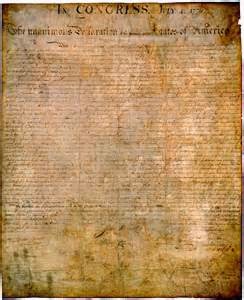
The Signers Of The Declaration Of Independence Were Declared Traitors By The King Of England

The Declaration Of Independence    

This is a post of a friend of mine, Gary Taylor, regarding the signing of the Declaration Of Independence and how special the 4th of July is in our history:


"On July 2nd 1776, about a year after the American Revolutionary War had begun, the elected leaders of the thirteen American Colonies voted to declare independence from Great Britain. On July 4th the declaration was ratified and signed by 56 patriots."

I suppose historians and folks much smarter then me will debate forever as to where and when, each of the 56 patriots actually signed the document. To me it really doesn’t matter where, or when… only thing that matters to me is the fact they had the courage to sign it.

You can bet each and every one of these brave and special men knew the dangers of signing such a document. There is much debate among historians as to what actually became of some of these men, but here is something that is not up for debate at all.

These men signed a document that gave birth to the idea of freedom, to the idea that the people of the land are best suited to control their own fate, not some hierarchy thousands of miles away.

By signing the document these men gave birth to America, the greatest nation on God’s green earth.

I am so thankful to be an American. I am proud of America and her accomplishments throughout our great history.

And I’ll be damned if I’ll apologize for it."


AMEN to that dear friend.  And may God continue to bless the United States of America. 

~~~~~~~~~~~~~~~~~~~~~~~~~~~~~~~~~~~~~

More on the 4th of July: 

The true meaning of the 4th of July 

The Fourth of July was the day (it was actually a few days earlier) the people of the thirteen colonies through their representatives in the Congress, declared to the world that they were now independent and free States. Free from the King and Parliament and a centralized government. However, it would take a long and bloody war to actually permit these newly independent Sates to remain free.

The Declaration of Independence was signed by men who knew they were risking their “Lives, fortunes and sacred honor”. According to the King, they were all traitors who warranted death.

When the war finally came to a successful end the King and Parliament had no choice but to declare that the thirteen States were now free. The first Article of the Treaty of Paris that ended the war stated:
His Brittanic Majesty acknowledges the said United States, viz., New Hampshire, Massachusetts Bay, Rhode Island and Providence Plantations, Connecticut, New York, New Jersey, Pennsylvania, Delaware, Maryland, Virginia, North Carolina, South Carolina and Georgia, to be free sovereign and Independent States; that he treats with them as such, and for himself his Heirs & Successors, relinquishes all claims to the Government, Propriety, and Territorial Rights of the same and every Part thereof.
It appears that we have forgotten who we are. The King had to sign a treaty that recognized all of the States independently. We are a union of States that remain free and independent. The Articles of Confederation, our first Constitution, and the current Constitution never gave up the Sovereignty of the States. In fact the States delegated only limited authority to the Federal government. The Tenth Amendment made it very clear.

How does the Declaration of Independence sum up? Read it carefully:
We, therefore, the Representatives of the united States of America, in General Congress, Assembled, appealing to the Supreme Judge of the world for the rectitude of our intentions, do, in the Name, and by Authority of the good People of these Colonies, solemnly publish and declare, That these united Colonies are, and of Right ought to be Free and Independent States, that they are Absolved from all Allegiance to the British Crown, and that all political connection between them and the State of Great Britain, is and ought to be totally dissolved; and that as Free and Independent States, they have full Power to levy War, conclude Peace, contract Alliances, establish Commerce, and to do all other Acts and Things which Independent States may of right do. — And for the support of this Declaration, with a firm reliance on the protection of Divine Providence, we mutually pledge to each other our Lives, our Fortunes, and our sacred Honor.
So this Fourth of July why not fly your State flag? It will show to the world that you are still a Sovereign and free people who choose to remain part of a union of States. How did John Adams say to celebrate: “…It ought to be commemorated as a day of deliverance by solemn acts of devotion to God Almighty. It ought to be solemnized with pomp and parade, with shows, games, sports, guns, bell, bonfires, and illuminations from one end of this continent to the other…”

Let’s not forget who we are.
Source: The Tenth Amendment Center
 

Wednesday, June 25, 2014

Constitutional Attorney, Jonathan Turley on 'dangerous' expansion of Obama's powers..."The Framers Would Be Horrified"

Jonathan Turley on 'dangerous' expansion of Obama's powers


Feb. 12, 2014 - 4:48 - Constitutional attorney reacts to the shift of gravity in Washington

The Rise of the Fourth Branch of Government


Below is today’s column in the Washington Post’s Outlook Section on the dangers of America’s growing administrative state. Ask any elementary student and you will hear how the Framers carefully designed a tripartite, or three-branch, system to govern the United States. This separation of powers was meant to protect citizens from tyranny by making every branch dependent on each other to carry out the functions of government. These three branches held together through a type of outward pressure – each holding the other in place through their countervailing forces. Add a fourth branch and the structure begins to collapse. That is precisely what is happening as federal agencies grow beyond the traditional controls and oversight of the legislative and executive branches. The question is how a tripartite system can function as a quadripartite system. The answer, as demonstrated by the last two decades, is not well. The shift from a tripartite to a quadripartite system is not the result of simply the growth in the size of the government. Rather, it is a concern with the degree of independence and autonomy in the fourth branch that led me to write this column.

There were times this past week when it seemed like the 19th-century Know-Nothing Party had returned to Washington. President Obama insisted he knew nothing about major decisions in the State Department, or the Justice Department, or the Internal Revenue Service. The heads of those agencies, in turn, insisted they knew nothing about major decisions by their subordinates. It was as if the government functioned by some hidden hand.

Clearly, there was a degree of willful blindness in these claims. However, the suggestion that someone, even the president, is in control of today’s government may be an illusion.

The growing dominance of the federal government over the states has obscured more fundamental changes within the federal government itself: It is not just bigger, it is dangerously off kilter. Our carefully constructed system of checks and balances is being negated by the rise of a fourth branch, an administrative state of sprawling departments and agencies that govern with increasing autonomy and decreasing transparency.

When James Madison and the other Framers fashioned a new constitutional structure in the wake of the failure of the Articles of Confederation they envisioned a vastly different government. Under the federalism model, states would be the dominant system with most of the revenue and responsibilities of governance. The federal government was virtually microsoptic by today’s standards. In 1790, it had just 1,000 nonmilitary workers. In 1962, there were 2,515,000 federal employees. Today, we have 2,840,000 federal workers in 15 departments, 69 agencies and 383 nonmilitary sub-agencies.  [These numbers can be themselves misleading since much federal work is now done by contractors as part of "downsizing" but the work of the agencies has continued to expand.  Moreover, technological advances have increased the reach of this workforce].

This  growth since the founding has led to increasing power and independence for agencies. The shift of authority has been staggering. The fourth branch now has a larger practical impact on the lives of citizens than all the other branches combined.

The rise of the fourth branch has been at the expense of Congress’s lawmaking authority. In fact, the vast majority of “laws” governing the United States are not passed by Congress but are issued as regulations, crafted largely by thousands of unnamed, unreachable bureaucrats. One study found that in 2007, Congress enacted 138 public laws, while federal agencies finalized 2,926 rules, including 61 major regulations.

This rulemaking comes with little accountability. It’s often impossible to know, absent a major scandal, whom to blame for rules that are abusive or nonsensical. Of course, agencies owe their creation and underlying legal authority to Congress, and Congress holds the purse strings. But Capitol Hill’s relatively small staff is incapable of exerting oversight on more than a small percentage of agency actions. And the threat of cutting funds is a blunt instrument to control a massive administrative state — like running a locomotive with an on/off switch.

The autonomy was magnified when the Supreme Court ruled in 1984 that agencies are entitled to heavy deference in their interpretations of laws. The court went even further this past week, ruling that agencies should get the same heavy deference in determining their own jurisdictions — a power that was previously believed to rest with Congress. In his dissent in Arlington v. FCC, Chief Justice John Roberts warned: “It would be a bit much to describe the result as ‘the very definition of tyranny,’ but the danger posed by the growing power of the administrative state cannot be dismissed.”
The judiciary, too, has seen its authority diminished by the rise of the fourth branch. Under Article III of the Constitution, citizens facing charges and fines are entitled to due process in our court system. As the number of federal regulations increased, however, Congress decided to relieve the judiciary of most regulatory cases and create administrative courts tied to individual agencies. The result is that a citizen is 10 times more likely to be tried by an agency than by an actual court. In a given year, federal judges conduct roughly 95,000 adjudicatory proceedings, including trials, while federal agencies complete more than 939,000.

These agency proceedings are often mockeries of due process, with one-sided presumptions and procedural rules favoring the agency. And agencies increasingly seem to chafe at being denied their judicial authority. Just ask John E. Brennan. Brennan, a 50-year-old technology consultant, was charged with disorderly conduct and indecent exposure when he stripped at Portland International Airport last year in protest of invasive security measures by the Transportation Security Administration. He was cleared by a trial judge, who ruled that his stripping was a form of free speech. The TSA was undeterred. After the ruling, it pulled Brennan into its own agency courts under administrative charges.

The rise of the fourth branch has occurred alongside an unprecedented increase in presidential powers — from the power to determine when to go to war to the power to decide when it’s reasonable to vaporize a U.S. citizen in a drone strike. In this new order, information is jealously guarded and transparency has declined sharply. That trend, in turn, has given the fourth branch even greater insularity and independence. When Congress tries to respond to cases of agency abuse, it often finds officials walled off by claims of expanding executive privilege.

Of course, federal agencies officially report to the White House under the umbrella of the executive branch. But in practice, the agencies have evolved into largely independent entities over which the president has very limited control. Only 1 percent of federal positions are filled by political appointees, as opposed to career officials, and on average appointees serve only two years. At an individual level, career officials are insulated from political pressure by civil service rules. There are also entire agencies — including the Securities and Exchange Commission, the Federal Trade Commission and the Federal Communications Commission — that are protected from White House interference.

Some agencies have gone so far as to refuse to comply with presidential orders. For example, in 1992 President George H.W. Bush ordered the U.S. Postal Service to withdraw a lawsuit against the Postal Rate Commission, and he threatened to sack members of the Postal Service’s Board of Governors who denied him. The courts ruled in favor of the independence of the agency.
It’s a small percentage of agency matters that rise to the level of presidential notice. The rest remain the sole concern of agency discretion.

As the power of the fourth branch has grown, conflicts between the other branches have become more acute. There is no better example than the fights over presidential appointments.
Wielding its power to confirm, block or deny nominees is one of the few remaining ways Congress can influence agency policy and get a window into agency activity. Nominations now commonly trigger congressional demands for explanations of agencies’ decisions and disclosures of their documents. And that commonly leads to standoffs with the White House.

Take the fight over Richard Cordray, nominated to serve as the first director of the Consumer Financial Protection Bureau. Cordray is highly qualified, but Republican senators oppose the independence of the new bureau and have questions about its jurisdiction and funding. After those senators repeatedly blocked the nomination, Obama used a congressional break in January to make a recess appointment. Since then, two federal appeals courts have ruled that Obama’s recess appointments violated the Constitution and usurped congressional authority. While the fight continues in the Senate, the Obama administration has appealed to the Supreme Court.
It would be a mistake to dismiss such conflicts as products of our dysfunctional, partisan times. Today’s political divisions are mild compared with those in the early republic, as when President Thomas Jefferson described his predecessor’s tenure as “the reign of the witches.” Rather, today’s confrontations reflect the serious imbalance in the system.

The marginalization Congress feels is magnified for citizens, who are routinely pulled into the vortex of an administrative state that allows little challenge or appeal. The IRS scandal is the rare case in which internal agency priorities are forced into the public eye. Most of the time, such internal policies are hidden from public view and congressional oversight. While public participation in the promulgation of new regulations is allowed, and often required, the process is generally perfunctory and dismissive.

In the new regulatory age, presidents and Congress can still change the government’s priorities, but the agencies effectively run the show based on their interpretations and discretion. The rise of this fourth branch represents perhaps the single greatest change in our system of government since the founding.

We cannot long protect liberty if our leaders continue to act like mere bystanders to the work of government.

Jonathan Turley is the Shapiro Professor of Public Interest Law at George Washington University.
Washington Post (Sunday) May 26, 2013

[The statistics on the rule-making and agency case figures in the piece came from Anne Joseph O'Connell, Vacant Offices: Delays In Staffing Top Agency Positions, 82 S. Cal. L. Rev. 913, 923 (2009) ]

Source: Jonathan Turley

Friday, June 6, 2014

D-Day Veteran: "Love your freedom, Because that's what we fought for. We fought for your freedom."


Visit NBCNews.com for breaking news, world news, and news about the economy
Video: The veteran NBC anchor reports on the day known as the greatest invasion in the history of mankind, and the story of one man who landed on Normandy’s Omaha Beach on June 6, 1944.

That same year, he landed on the Normandy beach code-named Omaha in a Higgins boat launched from the U.S.S. Samuel Chase to begin the assault. Seventy years later, he brought his entire family back to France to revisit that day, which began with the sounds of his fellow troops retching over the side of the boat followed by a hail of bullets from the Germans. 

"We had overfed the troops that morning,'' DeVita told Brokaw. "They were all seasick. When we got near the beach, one particular machine gun took a liking to us and was hitting my boat. The Germans had the high ground. They were shooting down at us. It was like hitting fish in a barrel."

An emotional DeVita recalled the fear of being ordered to drop the ramp to the boat. 

"I knew in my head, even though I was a young kid, when I drop that ramp, instead of the bullets hitting the ramp, they would come into the boat,'' he said. "So the coxswain says, 'Drop the ramp,' and I made believe I didn't hear him. So he said it a second time, and I made believe I didn't hear him. 

And the third time, he says, 'Goddamn, DeVita, drop the effin' ramp. 

"We had 30 men on the boat. Three men made it to the beach. They were all wounded and some were dead." 

DeVita can still remember the sounds of soldiers in their final moments.

"You know, there's a fallacy when a man is dying — they don't ask for God,'' he said. "The last word that that they say is, 'Mama, Mama." 

Those painful memories have been with DeVita for 70 years, and he is just sharing them now with his children. Four generations of his family joined him at the beach in Omaha to honor his service. 

DeVita returned because he feels a duty to speak for the men who died that day. 

"These kids were 18, 19 years old,'' he said. "They're never gonna see their son play Little League baseball. They're never gonna walk their daughter down the aisle, and they're never gonna hold their grandchild in their arms. They had their whole life ahead of them. 

"My family thinks I'm a hero. I'm not a hero. When you go up to the cemetery above Omaha, those are the heroes. Those are my heroes." 

DeVita is hoping his family and others take a lesson from the anniversary.

"Love your freedom,'' he said. "Because that's what we fought for. We fought for your freedom."

Tuesday, May 27, 2014

"I am not here as a serf or vassal. I am not begging my lords for mercy." "I’m a born free American woman, wife, mother and citizen. And I’m telling my government that you’ve forgotten your place

 "I am not here as a serf or vassal. I am not begging my lords for mercy." "I’m a born free American woman, wife, mother and citizen. And I’m telling my government that you’ve forgotten your place. It’s not your responsibility to look out for my well-being, and to monitor my speech. It’s not your right to assert an agenda. Your post, the post that you occupy, exists to preserve American liberty. You’ve sworn to perform that duty. And you have faltered." 
~Becky Gerritson of the Wetumpka Tea Party, testifying today before the House Ways and Means Committee about abuse by the IRS.~ 

Tuesday, February 18, 2014

Leftists Pushing To Make States Recognize International And Shariah Law

The radical leftists are at it again.  Pushing to force foreign laws  on us.  We must stop this effort to bring Shariah Law to the United States!  It's going to be up to you to make your voice heard on this issue.  Make sure you State Representative does not support this effort to destroy our Constitution and legal system! 
  ~~~~~~~~~~~~~~~~~~~~~~~~
The Brennan Center for Justice and the Shoulder to Shoulder Campaign present:

Webinar: Are Foreign Law Bans
a Threat to All Faiths?

Thursday, February 27, 2014 2:00 p.m. - 3:00 p.m 
featuring:
Amos Toh, Katz Fellow, Brennan Center for Justice
David L. Barkey, National Religious Freedom Counsel, Anti-Defemation League
Karen Georgia Thompson, Reverend, United Church of Christ  
 moderated by: 
 Christina Warner, Campaign Director, Shoulder to Shoulder Campaign
Please join us for a discussion about how your community can challenge anti-foreign law legislation in your state. Across the U.S., lawmakers are introducing bills that outlaw the use of religious, foreign, or international law in state courts, creating a host of problems for religious communities. Marriages, wills, divorces influenced by religious laws (like Jewish Halakha, Catholic Canon law, or Islamic Shariah law) could be negatively affected.


Although courts have found legislation explicitly targeting Shariah law to be unconstitutional, lawmakers in 35 states have tweaked and introduced bills banning foreign and international law over the last four years. In fact, seven states have passed anti-foreign law bills since 2010. While anti-Muslim sentiment is still motivating these laws, Americans of every faith should be concerned about their impact on their religious freedom.

Click here to RSVP. If you have any questions or concerns, please contact Christina Warner at cwarner@shouldertoshouldercampaign.org. 
###
Brennan Center for Justice at NYU School of Law | 161 Avenue of the Americas, 12th Floor | New York, NY 10013 | 646.292.8310 phone | 212.463.7308 fax | brennancenter@nyu.edu


  ~~~~~~~~~~~~~~~~~~~~~~~ 
Brennan Center For Justice is also behind the new move to make it easier to facilitate voter fraud:

URGENT CALL TO ACTION-LEFT WING GROUP TRYING TO CIRCUMVENT SCOTUS AND RIG ELECTION PROCESS

~~~~~~~~~~~~~~~~~~~~~~~

 More on what Shariah Law looks like: